


The best omega 3 source for dogs isn’t necessarily the one with the biggest “omega-3” figure on the label. What matters is which fatty acids it supplies: marine sources such as fish oil provide EPA and DHA directly, while plant oils such as flaxseed mainly provide ALA, which dogs convert to EPA and DHA only to a limited extent.
If you’re weighing whole fish against an oil supplement, or wondering whether a plant-based option can meet your dog’s needs, labels can be difficult to compare. This guide explains the differences between EPA, DHA and ALA, and compares fish, fish oil and plant-based sources to help you make an informed choice. You’ll learn which label details matter, including the amounts of EPA and DHA rather than just the total oil, and when to seek veterinary guidance. Fish oil is one option within a broader fish-based diet, but supplementation isn’t necessary for every dog. The right next step depends on your dog’s food, health and individual needs.
Key Takeaways
- The best omega 3 source for dogs depends on your dog’s diet, needs and the fatty acids a source provides.
- Compare oily fish, fish oil, algal oil and plant-based options by their typical fatty-acid contributions and formats.
- Use your dog’s food and life stage as a starting point before considering an additional source.
- Harley & Marley’s fish oil supplement is one option within its wider range of fish-based nutrition for dogs.
- Learn how to compare product labels and decide on a suitable next step, including when veterinary advice may help.
What are omega-3s for dogs, and why does the source matter?
Omega-3 fatty acids are a family of polyunsaturated fats that dogs obtain through their diet and use as part of normal body function. They’re not a single nutrient: the term covers several fatty acids with different structures and dietary sources. Start by understanding the differences between ALA, EPA and DHA rather than relying on an “omega-3” claim alone. The Omega-3 fatty acids overview explains the family’s structure and common sources.
That distinction helps answer a common question: the best omega 3 source for dogs depends partly on which fatty acids it supplies, as well as your dog’s existing diet and individual needs. Plant oil and fish oil may both contain omega-3s, but their fatty-acid profiles aren’t equivalent.
EPA, DHA and ALA: what is the difference?
ALA (alpha-linolenic acid) is a shorter-chain omega-3 found in plant sources such as flaxseed. EPA (eicosapentaenoic acid) and DHA (docosahexaenoic acid) are longer-chain omega-3s commonly found in oily fish and marine oils. Algal oils can also provide long-chain omega-3s.
Dogs can convert some ALA into longer-chain fatty acids, but this conversion is limited. ALA from flaxseed shouldn’t be treated as a direct substitute for dietary EPA and DHA. They belong to the same fatty-acid family, but they’re distinct nutrients. The source determines which fatty acids a food or supplement contributes.
Why does an omega-3 source matter for dogs?
Different sources provide different fatty-acid profiles. Oily fish and fish oil can supply EPA and DHA, while plant-based sources such as flax mainly provide ALA. Algal oil is another option, but its profile depends on the specific ingredient. Amounts can also vary within each source category, so a broad label claim doesn’t tell you the full nutritional picture.
Consider the whole diet, too. Complete food is formulated to provide a range of nutrients, and its overall balance matters more than adding one nutrient in isolation. Check the food’s formulation before considering an extra source, as a supplement may not be needed for every dog.
Life stage, current food, health and the reason for considering omega-3s can all affect suitability. If your dog has a health condition, takes medication or you’re unsure whether an additional source is appropriate, discuss the diet with your vet. This gives you a sound basis for comparing options.
Fish, fish oil, algae or plants: which omega-3 source suits dogs?
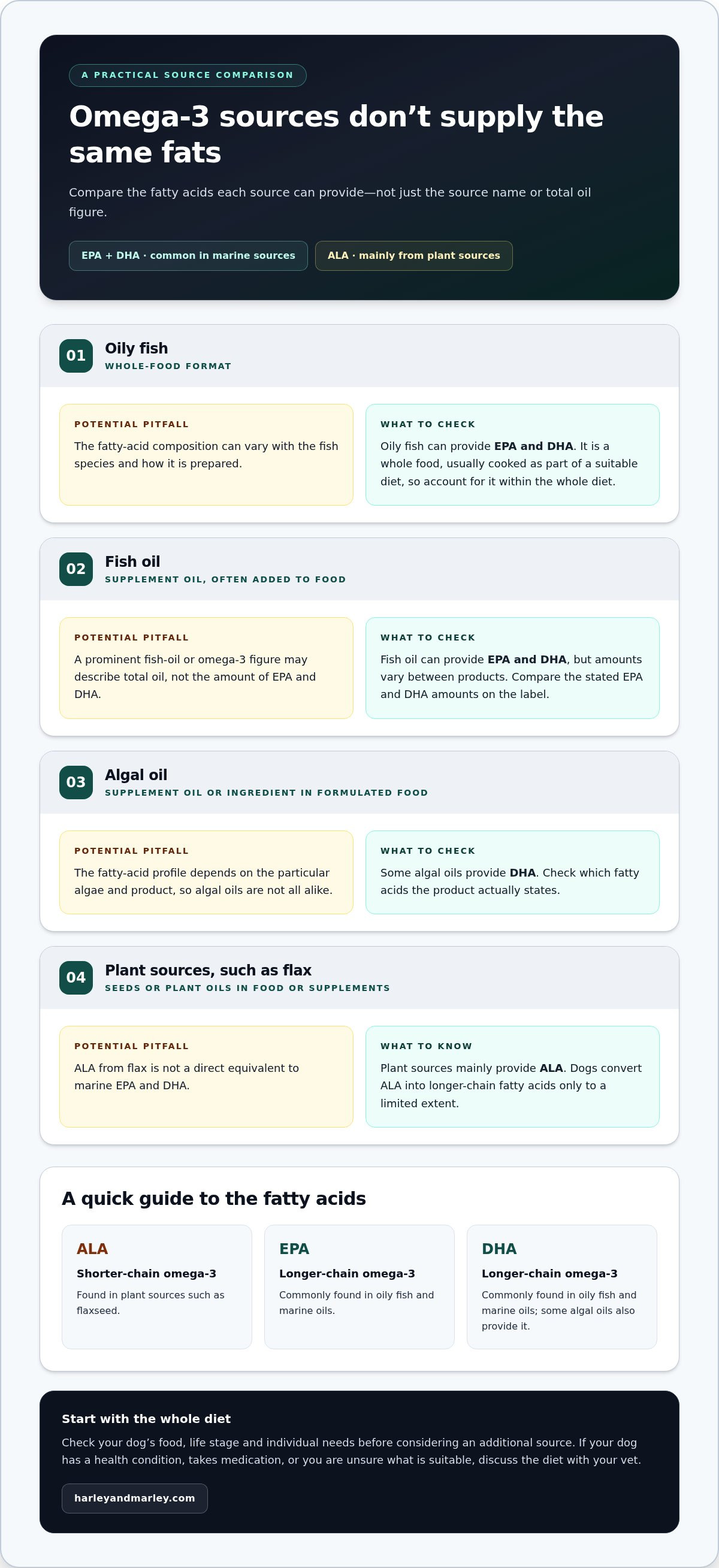
Each source has a different fatty-acid profile and practical format. The table gives a broad comparison, but the exact contribution depends on the ingredient and product. Check the label rather than assuming every source is equivalent.
| Source | Typical fatty-acid contribution | Practical format | Considerations |
|---|---|---|---|
| Oily fish | Can provide EPA and DHA | Whole food, usually cooked as part of a suitable diet | Species and preparation affect composition; account for the fish within the whole diet. |
| Fish oil | Can provide EPA and DHA | Supplement oil, often added to food | EPA and DHA amounts vary between products. Check the product label. |
| Algal oil | Some oils provide DHA; the profile depends on the algae and product | Supplement oil or an ingredient in a formulated food | Check which fatty acids are stated, as not every algal oil has the same profile. |
| Plant sources, such as flax | Primarily ALA | Seeds or plant oils used in food or supplements | Dogs convert ALA to longer-chain fatty acids inefficiently, so it isn’t a direct equivalent to marine EPA and DHA. |
Oily fish and fish oil: what distinguishes them?
Oily fish is a whole food that contributes nutrients as part of a meal; fish oil is a more concentrated supplement format. They’re related sources, but they fit into a diet differently. Fish species, processing and formulation can all affect the oil’s composition. For a product-specific comparison, look for the stated EPA and DHA amounts rather than relying only on the total oil quantity. VCA Animal Hospitals on fish oil also explains the roles of these fatty acids and why veterinary guidance can matter.
Can algae or plant-based sources provide an alternative?
Algal oil can provide DHA, though its fatty-acid profile depends on the particular oil. It may suit owners seeking a non-fish oil option, but compare the stated nutrients with your dog’s dietary needs. Flax and similar plant sources provide ALA. Because dogs convert ALA into EPA and DHA only to a limited extent, a plant-based source shouldn’t automatically be considered an equivalent replacement for fish oil.
There’s no single winner for every dog. The best omega 3 source for dogs depends on the fatty acids supplied, your dog’s existing food and the reason for considering another source. Harley & Marley offers fish oil alongside fish-based complete foods for different life stages. Explore its fish oil and fish-based nutrition, and speak with your vet if you’re unsure what fits your dog’s diet.
How to compare omega-3 products for dogs without being misled by the label
A prominent “fish oil” or “omega-3” figure can look informative, but it may describe the total oil rather than the EPA and DHA it contains. To compare products meaningfully, look beyond the front of the pack and review the ingredient, fatty-acid and intended-use information. This gives you a clearer basis for deciding whether a product fits your dog’s existing diet.
Which label details are worth comparing?
Use this checklist to assess what the label tells you:
- EPA and DHA amounts: Check whether each is stated, and note the amount per serving or measured quantity, such as per millilitre or capsule. If the label gives only total oil, that figure alone won’t tell you how much EPA and DHA it supplies.
- Ingredients and source: Look for the named oil or other omega-3 source, plus any additional ingredients. Clear information makes it easier to understand what you’re adding to your dog’s food.
- Format and intended use: Check whether it’s an oil, capsule or another format, and read the feeding directions. Don’t assume directions for one product apply to another.
- Storage and use-by information: Follow the stated storage instructions and note any guidance for after opening. These details help you handle the product as intended.
For example, a large total-oil quantity on the front doesn’t reveal the specific EPA and DHA amounts. Compare those figures where they’re available, rather than treating total oil as a measure of active omega-3 content.
What do freshness and product quality mean in practice?
Oils can oxidise through exposure to factors such as air, light and heat, which can affect their quality. Packaging and storage instructions are useful practical details, but packaging alone doesn’t prove freshness, purity or potency. Check the product’s use-by information, follow its storage directions and look for clear ingredient and fatty-acid information. Don’t infer that a product is superior, sustainably sourced or free from contaminants unless the label or supporting evidence substantiates that claim.
Tufts veterinary nutrition discusses how omega-3 sources differ and why an animal’s health can affect whether supplementation is appropriate. A label checklist is a useful starting point, not a personalised feeding plan. Your dog’s complete diet, health and any medicines they take also matter. If you’re considering a supplement for a specific health concern, ask your vet for guidance. That context helps you judge the best omega 3 source for dogs without relying on a headline claim alone.
How to choose an omega-3 source for your dog’s diet and life stage
A thoughtful choice starts with your dog’s whole diet, not a supplement label in isolation. Follow these steps to work out what information you need and whether an additional omega-3 source is appropriate.
- Review your dog’s current food. Check the packaging or product information to understand its formulation and whether it already contributes omega-3 fatty acids. Include treats and any supplements when considering the overall diet.
- Identify why you’re considering omega-3s. Is it a general nutrition question, or are you concerned about a specific health issue? Health concerns call for veterinary guidance rather than self-prescribing a supplement.
- Compare suitable source types. Consider how fish, fish oil, algal oil or plant sources fit with the food your dog already eats. Their fatty-acid profiles differ, so match the source to the nutritional question you’re trying to answer.
- Read the product information. Where stated, compare EPA and DHA amounts, ingredients, feeding directions and storage instructions. Don’t assume that a larger total-oil figure means more of a particular fatty acid.
- Seek tailored advice when needed. If your dog has a health condition, takes medication or has a special dietary requirement, discuss the whole diet and any planned supplement with your vet.
Complete food is formulated to provide a range of nutrients, but formulations differ. Check the information for your dog’s specific food rather than assuming all complete diets contribute the same omega-3s. Harley & Marley’s range includes fish-based complete foods for different life stages. For broader context, read about fish-based dog food nutrition.
Should every dog have an omega-3 supplement?
No. A supplement isn’t automatically necessary just because omega-3s are part of canine nutrition. Whether one makes sense depends on your dog’s existing food, overall diet and individual circumstances. Don’t use a supplement as a treatment for a health condition or apply a universal dose. If you’re considering omega-3s to address a health concern, ask your vet to assess your dog’s needs.
How can life stage and diet affect the decision?
Puppies, adult dogs and senior dogs can have different nutritional needs, but age alone doesn’t determine whether a supplement is suitable. For a puppy, consider food formulated for growth and discuss any additional product with your vet; our guide to fish-based puppy nutrition offers relevant diet context. For a senior dog, changes in health or diet are a good reason to seek tailored veterinary advice.
If you’re exploring an additional fish-based option, view Harley & Marley’s fish oil. It’s one choice within a wider fish-based nutrition range, not a requirement for every dog.
A fish-based omega-3 option from Harley & Marley
For owners considering a marine-source supplement, Harley & Marley offers fish oil for dogs as part of a wider fish-based nutrition range. It’s an option to consider, not a recommendation that every dog needs a supplement. Suitability depends on what your dog already eats, their individual circumstances and the reason for considering an additional source.
Where does fish oil fit within fish-based nutrition?
Fish oil and complete food have different roles. A supplement adds to a diet; it isn’t a replacement for complete, balanced food. Harley & Marley’s range includes fish-based complete food for puppies, small breeds, medium and large breeds, and senior dogs, alongside fish oil. Reviewing the food’s formulation can help you understand what it already contributes before deciding whether to add anything.
This is particularly relevant if your dog’s needs have changed with age or health. For senior dogs, a change in appetite, condition or overall diet is a good reason to discuss tailored nutrition with your vet. Harley & Marley’s guide to fish oil guidance for senior dogs provides further diet context.
What should owners do before adding a supplement?
Review the whole picture before introducing fish oil. A simple check can make a conversation with your veterinary professional more useful:
- Check the current food: Review its formulation and feeding guidance, and note whether it already contributes omega-3 fatty acids.
- List other additions: Include treats and any supplements your dog receives, so you can consider the diet as a whole.
- Explain the reason: If you’re responding to a health concern, mention it and share details of any medication or other relevant health information with your vet.
- Follow guidance: If you decide to use a supplement, follow its label and any veterinary advice. Don’t assume a dose from another product or dog is suitable.
The best omega 3 source for dogs is the one that fits the individual dog’s diet and needs, rather than an extra ingredient added by default. Harley & Marley’s fish oil sits within a broader fish-based approach to canine nutrition, while complete food remains the foundation of daily feeding. For a practical next step, explore Harley & Marley’s fish-based nutrition.
Make an informed choice for your dog
The best omega 3 source for dogs depends on the fatty acids it provides and how it fits with your dog’s complete diet. Fish and fish oil can supply EPA and DHA, while plant sources such as flax mainly provide ALA, which dogs convert only to a limited extent. These sources aren’t interchangeable.
Before adding a supplement, review your dog’s current food and compare product labels for stated EPA and DHA amounts, ingredients and feeding directions. A large total-oil figure alone doesn’t show how much of these specific fatty acids a product contains. Supplementation isn’t automatically necessary, and your dog’s age, health and individual diet can all affect what’s suitable. If you’re considering omega-3s for a health concern or feel unsure, speak with your vet.
Harley & Marley offers fish oil supplements alongside fish-based complete food for multiple life stages, giving you options to explore within a wider nutrition range. Explore Harley & Marley’s fish-based nutrition as you consider what may suit your dog. Review the diet and seek the right guidance before deciding on an additional source.
Frequently Asked Questions
What is the best omega-3 source for dogs?
There isn’t one best source for every dog. Fish and fish oil can provide EPA and DHA directly, while some algal oils provide DHA; plant sources such as flax mainly supply ALA, which dogs convert to EPA and DHA only to a limited extent. The best omega 3 source for dogs depends on your dog’s current food, the fatty acids a source supplies and individual needs. Ask your vet if health concerns are involved.
Is fish oil or whole fish better for dogs?
Neither is universally better; they have different roles and formats. Whole fish is a food that contributes to the overall diet, while fish oil is a supplement. The fatty-acid profile can vary with the fish and the product, so don’t assume all oils provide the same amounts of EPA and DHA. Check the food or supplement information, and consider how it fits with your dog’s complete diet. If learning about quality fish sources also inspires your own pantry choices, traditional producers such as Conserverie Maison Marthe offer a gourmet take on artisanal preserved seafood for home dining.
Can dogs get omega-3 from plant sources such as flaxseed?
Yes. Flaxseed and other plant sources provide ALA, a type of omega-3. However, dogs convert ALA into the longer-chain fatty acids EPA and DHA only to a limited extent. Flax shouldn’t automatically be treated as an equivalent replacement for fish oil or another source of EPA and DHA. If you’re choosing a source for a particular dietary or health need, discuss the options with your vet.
How much omega-3 should I give my dog?
There isn’t a single suitable amount for every dog, and a dose shouldn’t be chosen from total oil quantity alone. The National Research Council gives a general supplemental reference of 50-75 mg of combined EPA and DHA per kilogram of body weight per day. This isn’t an individual prescription. Ask your vet whether supplementation is appropriate and what amount suits your dog’s diet, health and circumstances.
What should I look for on a dog omega-3 supplement label?
Look for clear ingredient information and, where provided, the separate amounts of EPA and DHA per serving or measured quantity. A large total-oil figure doesn’t tell you how much of these fatty acids the product contains. Also check feeding directions, intended format, use-by information and storage instructions. If the label doesn’t give the detail you need to compare products, ask your vet for help assessing whether it suits your dog.
Can I give my dog fish oil if they already eat fish-based food?
Possibly, but fish-based food doesn’t automatically mean your dog needs extra fish oil. Review the specific food’s formulation and consider any other supplements or treats as part of the overall diet. Adding oil without assessing the full picture may not be appropriate for every dog. If your dog has a health condition, takes medication or you’re unsure, discuss the food and supplement with your vet first.
Is algae oil a good omega-3 source for dogs?
Algal oil can be an option: some algae oils provide DHA, although the fatty-acid profile varies by source and product. Check the label to see which omega-3s are stated rather than assuming all algal oils are alike. Its suitability depends on your dog’s diet and the reason you’re considering it. If you need a source for a particular health concern, ask your vet for tailored advice.