


Searching for complete puppy food small breed options? A bag marked “puppy” or “small breed” may look suitable, but the label’s feeding and product information is what helps you compare foods carefully.
Start with your puppy’s growth stage. Then check that the food is labelled complete, intended for puppies or growth, and comes with feeding guidance you can follow. These checks matter more than a prominent marketing claim.
This guide explains how to assess complete puppy food, compare labels and build a manageable feeding routine. You’ll learn which details to check, how to use a product’s feeding guide and what to monitor as your puppy grows. The aim is a clear, repeatable way to make and review your choice.
Key Takeaways
- Start with your puppy’s growth stage, then look for clear wording that identifies the food as complete.
- Compare complete puppy food small breed options using the same checks: life-stage wording, feeding guidance and ingredient information.
- A small-breed label can help narrow your search, but it does not replace checking that the food is intended for puppies.
- Use the product’s feeding guidance to build a steady routine, and monitor your puppy’s appetite, body condition and growth.
- Fish-based complete food for puppies and small breeds is one option to assess using the same label checklist.
What does complete puppy food for small breeds mean?
A complete food is formulated to provide a dog’s daily nutritional needs when fed as directed. A complementary feed is intended to be combined with other food, so it is not designed to make up the whole diet on its own.
Complete puppy food is intended to provide the nutrients a growing puppy needs when fed according to its feeding guidance. For a small-breed puppy, check both the complete-food statement and the life-stage wording. “Small breed” is useful context, but it does not replace either check.
Complete food versus complementary feed
Look for the food category on the packaging rather than relying on prominent words or pictures on the front. “Complete” indicates that the food can form the main diet when used as directed. “Complementary” means it should be served alongside other food.
Treats and supplements are not substitutes for a complete diet. They can be part of a feeding routine, but their presence in a product or ingredient list does not mean they provide everything a puppy needs. Check the life-stage wording too: look for “puppy”, “growth” or another clear indication that the food is designed for growing dogs. Do not assume food labelled for adult dogs is suitable for puppies simply because it is described as complete.
Puppies’ nutritional needs differ from those of adult dogs. For a broader overview, see Dog food nutritional requirements, which discusses how nutritional considerations vary with age and breed. Use that context to understand why the food’s own puppy or growth wording matters.
What small-breed suitability tells you
Small-breed wording can help narrow your search to products positioned for smaller dogs. It is a useful starting point, particularly when a range has separate puppy and small-breed categories. On its own, though, it does not show that a food is complete or intended for a puppy’s growth.
Read the wording as a clue, not proof. A product labelled for small breeds still needs a clear complete-food declaration and puppy or growth-stage suitability. Similarly, “puppy food” does not necessarily mean the product is positioned specifically for smaller dogs. Check the label details rather than treating category names as nutritional information.
Small-breed puppies differ in age, expected adult size, activity and individual circumstances. A size label cannot tell you everything about your dog. Match the stated life stage to your puppy, confirm the food is complete, then follow its feeding guidance. This gives you a consistent basis for assessing a complete puppy food small breed option without mistaking product positioning for evidence of suitability.
How to assess a small-breed puppy food label
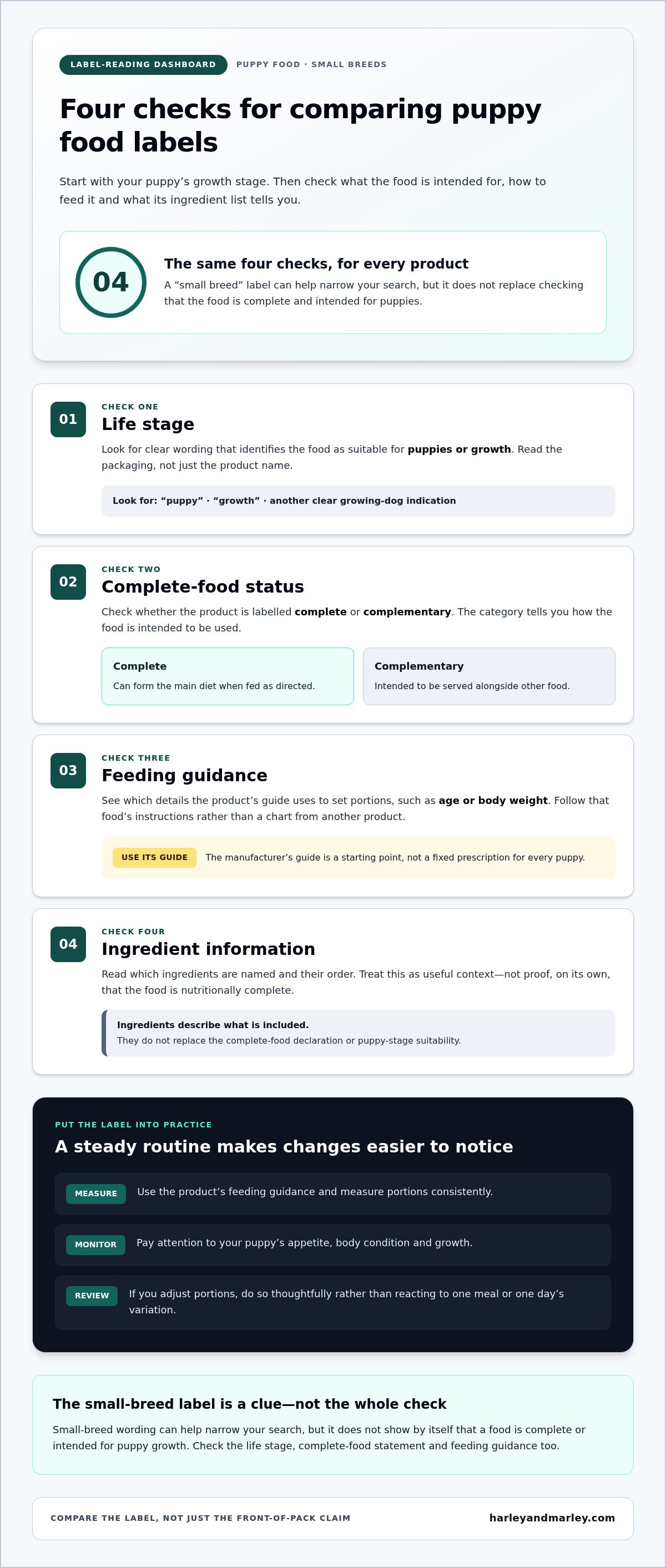
Use the same label checks for every product rather than judging a bag by its front-of-pack claims. Check the life stage, complete-food statement, feeding guide and ingredient information. Together, these details show what the food is intended for, how to use it and what it contains.
- Life stage: Look for wording that identifies the food as suitable for puppies or growth. Read the packaging, not just the product name.
- Complete status: Check that the food is labelled complete rather than complementary. This tells you whether it is intended to provide the whole diet when fed as directed.
- Feeding guide: See which details the guide uses to set portions, such as age or body weight. Follow the instructions for that particular food, not a chart from another product.
- Ingredient information: Read the ingredient list to see which ingredients are named and their order. Treat it as useful context, not proof on its own that the food is nutritionally complete.
Check life-stage and complete-food statements
Check the packaging’s product and feeding information for both the intended life stage and the complete-food wording. These details may be away from the product name, so read more than the front panel. Adult maintenance food is not automatically interchangeable with puppy food: the label should show that the product is intended for a growing dog. For broader context on small-dog nutrition, VCA Hospitals’ guide to nutritional needs of toy and small dog breeds discusses considerations for these dogs, including life stage.
Use the feeding guide as a starting point
The manufacturer’s guide is a product-specific starting point, not a fixed prescription for every puppy. Use the details requested on the packaging to select a portion, and measure it consistently so you can observe your puppy’s routine over time. Do not borrow a gram amount from another brand: feeding instructions vary between foods, and the appropriate portion depends on both the product and the individual puppy.
Pay attention to appetite and body condition as your puppy grows. If you adjust portions, do so thoughtfully rather than reacting to one meal or one day’s variation. A consistent routine makes it easier to notice changes and use the food’s guidance sensibly.
Ingredient order alone cannot tell you whether a recipe provides the full nutritional profile a growing puppy needs. An ingredient near the start of a list may catch your eye, but the complete-food declaration and puppy-stage suitability are separate details. Ingredients describe what is included; they do not replace the label’s statement about how the food is intended to be fed.
Use this checklist to compare a complete puppy food small breed option consistently, rather than letting a single front-of-pack claim decide. If fish-based food is part of your search, explore complete food for puppies and small breeds and assess it against the same label details.
Is small-breed puppy food really different from standard puppy food?
“Small breed” can help narrow a search, but it is not a quality rating or a guarantee that a food suits every puppy. First check whether the label says the food is complete and intended for growth. Then consider the breed-size wording and other product information.
Think of the categories this way:
- Small-breed puppy food: positioned for puppies of smaller breeds. Check that the pack also identifies it as complete and suitable for puppies or growth.
- General puppy food: intended for growing dogs, but not necessarily positioned specifically for small breeds. Assess its stated life stage and feeding guidance rather than assuming the broader wording makes it unsuitable.
- Adult food: intended for adult maintenance. A complete-food statement alone does not make it interchangeable with food intended for a growing puppy.
What the small-breed label can and cannot tell you
Breed-size wording is a product-selection cue. It can help you find relevant options, but it does not assess your individual puppy or prove that the food is complete. Prioritise the complete-food statement and clear puppy or growth-stage wording. Then read the product’s own feeding information. A size label adds context; it does not replace these checks.
“Breed-specific” does not automatically mean “better”. Clear, relevant label information is more useful than a broad claim on the front of a pack. Puppies of the same breed can differ in age, expected adult size and individual circumstances, so a category name cannot make the decision for you.
How to compare two puppy foods fairly
Put the product information side by side and compare like with like. First, check that both foods are intended for puppies or growth. Next, confirm that each is labelled complete. Then compare their feeding instructions, including how each guide tells you to choose a portion. This gives you practical details to assess without treating advertising language as nutritional evidence.
Words such as “premium”, “natural” or “breed-specific” may describe how a food is presented, but they do not establish its life-stage suitability or complete status. Read the package details that answer those questions directly. Clear feeding information is more useful than a prominent claim that does not explain how the food is intended to be used.
Grain-free is another product characteristic, not proof that a food is complete or superior. The term alone does not tell you whether a food is suitable for a puppy’s growth. Apply the same checks whether a product is grain-free or contains grains.
For another perspective on comparing options, this small-breed fish-food buying guide can help you consider fish-based choices alongside the information on their labels.
How to feed complete food to a small-breed puppy
A steady routine makes it easier to observe how your puppy responds to their food. Start with the selected product’s feeding guide, measure portions consistently and keep fresh water available. Treat the guide as a starting point, then observe your puppy over time rather than changing the amount in response to one meal or one day.
Portions, routine and monitoring
Use the feeding guide on your chosen food and follow the details it asks for when selecting a starting portion. Measure each serving in the same way and keep meal times as consistent as practical. Treats also contribute to what your puppy eats across the day, so include them in your routine rather than allowing them to replace complete food.
Observe appetite, body condition and growth over time. These observations can help you notice changes, but they cannot diagnose a health problem. If you’re concerned about your puppy’s appetite, weight or growth, seek veterinary advice rather than making a major feeding change based on guesswork.
Changing food without making assumptions
If you’re changing foods, a measured transition is preferable to an abrupt switch where practical. Follow any transition advice provided with the food, and note your puppy’s appetite and stools as the new food is introduced. These observations provide context, but a change does not automatically show that a particular ingredient is responsible.
Keep the routine simple: follow the directions for the food you’re serving, measure consistently and make changes thoughtfully. Do not apply one product’s portion guide to another, because the instructions are specific to that food. If your puppy seems unwell or you’re worried about a persistent change, seek veterinary advice.
For broader feeding context, puppy food guidance for Ireland can help you think through food choices during growth. The same approach applies to a complete puppy food small breed option: follow its own directions and observe your puppy rather than relying on a generic portion or timetable.
Monitor responsibly: follow the food’s guide, keep portions consistent and pay attention to your puppy’s appetite, body condition and growth. If you’re comparing fish-based options, explore complete food for puppies and small breeds and assess the product information alongside your feeding routine.
Choosing Harley & Marley complete food for your puppy
Use the same practical checks for every puppy food: match its stated life stage to your dog, look for complete-food wording, read the feeding guidance and treat ingredient information as one part of the picture. Apply them consistently, whether you’re comparing fish-based food or another type. The product information, not a broad front-of-pack claim, should guide your decision.
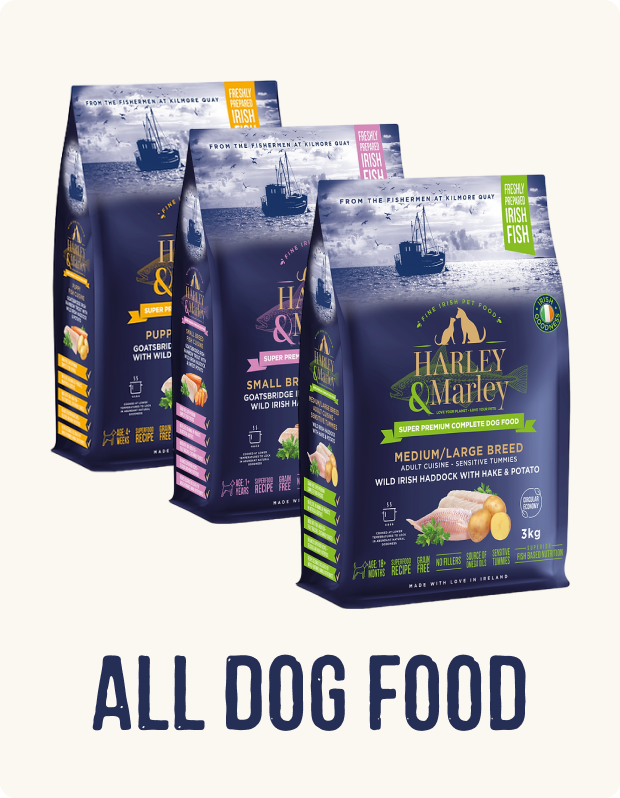
Harley & Marley specialises in fish-based complete dog food and offers food for puppies and small breeds. Its range is a relevant option if you’re considering fish-based food. Read the product information to understand the intended life stage and how the food is meant to be fed.
A fish-based option for puppy feeding
Apply the checklist to the specific food you’re considering. Look for clear wording about whether it is complete and intended for puppies or growth. Then follow that product’s feeding guidance rather than assuming the directions for another food will be the same. Ingredient details can help you understand what is listed, but they do not replace the complete-food and life-stage information.
This keeps your decision grounded in details you can assess, rather than assumptions about what “fish-based” or “small breed” means. For more context on puppy feeding and fish-based nutrition, the fish-based puppy-food guide offers a related perspective. Use it alongside the wording and directions on the product you’re considering.
Explore the range with confidence
Harley & Marley offers Puppy Complete Food and Small Breed Complete Food categories. As you explore them, keep your puppy’s current growth stage in focus and use the product’s own information and feeding instructions to decide whether it fits your needs. Do not infer particular ingredients, kibble dimensions or nutrient levels from a category name; rely on the product information for those details.
A confident choice can be straightforward. Confirm the intended life stage, check the complete-food statement and make sure you understand the feeding guidance before building the food into your routine. These checks help you compare options without relying on marketing language alone.
If you’re considering fish-based food, explore Harley & Marley dog food and use the same label checklist as you browse the range.
Choose the next step with confidence
Your puppy’s food choice is not a one-time decision. Keep the packaging and feeding guidance to hand so you can review your routine as your puppy grows or their appetite, body condition or daily pattern changes. If you’re concerned about growth or weight, seek veterinary advice.
A calm, observant approach makes choosing complete puppy food small breed more manageable. Focus on what suits your puppy’s current stage and on information you can assess, rather than chasing every new claim. Give the routine time to settle, and make adjustments thoughtfully as your puppy develops.
Harley & Marley offers fish-based complete food for puppies and small breeds, including grain-free options. Explore Harley & Marley dog food to find an option for your puppy and review its product and feeding information.
Frequently Asked Questions
What does complete puppy food mean?
It means the food is intended to provide a puppy’s daily diet when fed according to its instructions. Check the packaging for both the complete-food statement and wording that identifies it for puppies or growth. A treat labelled complementary, for example, is not designed to replace meals, even if it contains ingredients also found in dog food. Keep extras within the feeding routine rather than using them as a substitute for complete food.
Can a small-breed puppy eat food labelled for all puppies?
A food labelled for all puppies may suit a small-breed puppy if the packaging identifies it as complete and intended for growth. The phrase “all puppies” is not enough on its own, so read the feeding directions and any stated limitations. A puppy with individual dietary needs may need a different approach. If you’re unsure what suits your dog, seek veterinary advice.
How often should I feed a small-breed puppy?
Meal frequency depends on your puppy’s age, the food’s instructions and their individual routine. Use the product guidance as your starting point, then divide the recommended daily amount into regular meals that work for your puppy. For example, measure the day’s allowance first and portion it out instead of repeatedly topping up the bowl. If you’re unsure how often to feed a very young puppy, seek veterinary advice suited to their needs.
How do I know if I am feeding my puppy the right amount?
Use the food’s daily feeding guide, measure portions consistently and observe your puppy over time. Keep a simple note of the amount offered, appetite and any noticeable change in body condition or growth. One uneaten meal or a change in appetite does not establish whether the portion is right. If weight, growth or eating habits concern you, seek veterinary advice before making a substantial change to the feeding amount.
Can I mix wet and dry complete puppy food?
Yes, provided both foods are complete and intended for puppies or growth. Combine them as portions of the daily allowance rather than serving a full recommended amount of each food. Check both feeding guides and follow any mixing instructions on the packaging. If the foods give guidance in different formats or you’re unsure how to balance the portions, seek veterinary advice.
Is grain-free complete puppy food necessary?
No, grain-free food is not automatically necessary for a puppy, and “grain-free” alone does not mean a food is complete or better suited to growth. Focus first on the food’s life-stage wording and complete status. If a vet has advised a particular diet because of your puppy’s individual circumstances, follow that guidance. Harley & Marley offers grain-free options, which you can assess using the same label checks as other puppy foods.
When should a small-breed puppy move to adult food?
Make the change when your puppy is approaching maturity rather than choosing a date based on size alone. Timing varies between dogs, so consider the food’s life-stage guidance and seek veterinary advice if you’re unsure. When it is appropriate to change, introduce the adult food gradually where practical and observe how your dog responds. Do not switch to adult food simply because your puppy looks close to full size.