


A grain-free label doesn’t automatically make a dog food the healthier choice. If you’re comparing dog food without grains or fillers, start with the information on the pack: what the recipe contains, whether it’s complete or complementary, and which dogs it’s intended for. Those details answer more than a front-of-pack claim can.
It’s sensible to look closely at what goes into your dog’s bowl, but marketing terms can make ordinary ingredients sound harmful. “Fillers” has no official definition, and removing grains alone doesn’t show that a food is complete or well balanced. What matters is whether the food provides the nutrients your dog needs for their life stage and individual circumstances.
This guide explains what grain-free and filler-free claims do and don’t mean, how to assess a food’s nutritional declaration and feeding guidance, and what to check before making a change. It also covers when to ask your vet first, so you can compare options, including fish-based grain-free foods, with greater confidence.
Key Takeaways
- “Grain-free” describes what a recipe excludes, while “filler-free” is a marketing phrase, not a guarantee of better nutrition.
- Check the food’s declared purpose and complete or complementary status alongside its ingredient list. Ingredients alone can’t confirm suitability for your dog.
- Choosing dog food without grains or fillers doesn’t automatically mean choosing a healthier diet. Discuss suspected allergies or intolerances with your vet.
- Start with your dog’s age, size, activity and health needs, then check the individual product label for feeding guidance and life-stage suitability.
- Harley & Marley is an Irish-owned business offering fish-based food, including grain-free options. Check each current label before choosing.
Dog food without grains or fillers: what do these claims mean?
“Grain-free” means a recipe excludes grains, but it doesn’t tell you what ingredients replace them or how the food is formulated. Recipes vary, so check the product label. A grain-free food may still contain carbohydrates from other sources, and excluding grains alone doesn’t make a food healthier, more digestible or suitable for every dog.
An ingredient exclusion claim tells you what a food leaves out; it doesn’t prove the food is complete or nutritionally suitable. For a broad overview of Dog food, including grain-free diets, see the linked reference. For a particular food, rely on its current label and feeding guidance.
What does grain-free dog food exclude?
Grains commonly listed on dog-food labels include wheat, maize, rice, barley and oats. A grain-free recipe excludes grains but may use other carbohydrate sources instead, such as potato or pulses. Don’t assume that a grain-free label means a food contains no carbohydrates. Check the ingredients to see what the recipe uses, rather than judging it by the claim on the front of the pack.
Nor does every dog need to avoid grains. If you’re considering dog food without grains or fillers because of a suspected sensitivity, seek veterinary advice instead of relying on a label alone.
Is “filler-free” a meaningful label claim?
“Filler” is a marketing term, not a specific ingredient or a reliable measure of nutritional value. It may suggest that an ingredient adds bulk without contributing much, but the phrase doesn’t identify the ingredient or explain the food’s composition. An unfamiliar ingredient isn’t automatically poor quality, just as a familiar one isn’t automatically beneficial or harmful.
Assess the whole picture: what the ingredients contribute, whether the food is labelled complete or complementary, and whether its feeding guidance fits your dog. Ingredients help you understand what’s included, but they don’t show on their own whether a food provides the right balance for an individual dog. Look beyond “filler-free” and compare the product’s stated purpose with its nutritional information.
How to assess ingredients in dog food without grains or fillers
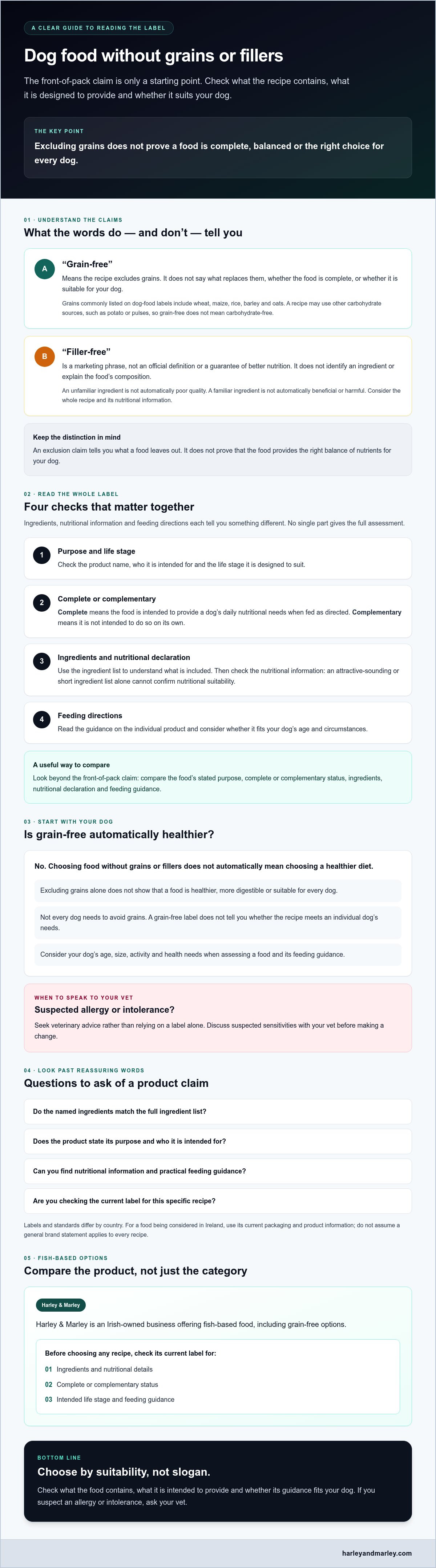
Look beyond the front-of-pack claims. To compare dog food without grains or fillers, first establish what the food is designed to provide. Then assess its ingredients, nutritional information and feeding directions together. A list of attractive-sounding ingredients can’t tell you on its own whether the food meets your dog’s needs.
A complete nutritional profile matters more than a short ingredient list, because your dog needs the right balance of nutrients, not simply fewer listed ingredients.
Which label details deserve attention?
Check the product name and intended life stage, then look for a clear statement that the food is complete or complementary. A complete food is intended to provide a dog’s daily nutritional needs when fed as directed; a complementary food is not intended to do so on its own. Read the nutritional declaration and feeding directions, and check that they suit your dog’s age and circumstances.
Labels and standards differ by country. The FDA regulation of pet food page explains the US system, so it shouldn’t be read as guidance on Irish requirements. For a food you’re considering in Ireland, use its current packaging and product information. Check specific claims against that product’s label rather than assuming a general brand statement applies to every recipe.
How do you spot vague or unsupported claims?
Words such as “natural” and “filler-free” may sound reassuring, but they don’t explain the food’s nutritional adequacy. Treat them as prompts to look more closely. Do the named ingredients match the full ingredient list? Does the product description state its purpose and who it’s intended for? Can you find practical feeding guidance and nutritional information?
Ingredient names can be unfamiliar without indicating poor quality. Consider the role of each ingredient in the overall recipe, not whether its name sounds familiar or appears near the top of the list. The ingredient list, nutritional declaration and feeding directions each provide different information; none is a complete assessment on its own.
For a practical comparison, review Harley & Marley’s grain-free dog food options and check each product’s current label for ingredients, nutritional details and feeding guidance.
Is grain-free dog food healthier? What owners should know
Removing grains doesn’t, by itself, make a food healthier or more suitable for your dog. A grain-free recipe may suit an individual dog, but the decision should reflect their nutritional needs and health history, not an assumption that grains are harmful. Dog food without grains or fillers still needs to provide suitable, complete nutrition if it’s intended to be your dog’s main food.
Diet should suit the individual dog. Whether particular grain-free formulations are linked to heart disease remains a complex scientific question, not proof that grains or grain-free food cause disease.
When might a grain-free diet be considered?
A dog’s itching, digestive upset or other symptoms can have several possible causes. Noticing symptoms after a meal may raise a question, but it doesn’t confirm a food allergy or intolerance. A vet can assess your dog’s signs and medical history and advise whether a dietary change is appropriate. Avoid removing ingredients or switching foods based on guesswork, as the replacement still needs to meet your dog’s nutritional needs.
If a change is recommended, ask how to follow the advice and what to monitor. Keep the product label and feeding details available, and check that the chosen food is complete and suitable for your dog’s life stage.
What should owners know about diet-related heart concerns?
Canine dilated cardiomyopathy (DCM) is a condition in which the heart muscle becomes weakened and enlarged, affecting its ability to pump blood effectively. The US Food and Drug Administration began investigating reports of DCM in dogs eating certain diets in 2018. As of June 2026, the FDA had not established a direct causal relationship between grain-free food and DCM. The issue is considered complex, with possible roles for factors such as genetics, formulation and individual metabolism.
Evidence continues to develop. The Dog Aging Project’s 2026 research found no statistically significant association between grain-free diets and new cardiac diagnoses. That finding provides useful context, but it doesn’t establish that every formulation is suitable for every dog or settle all questions about diet and heart health.
Don’t treat the presence or absence of grains as a diagnosis or a guarantee of safety. If your dog has a health concern, or you’re considering a significant diet change, discuss the options with your vet. They can help weigh your dog’s individual needs against the current evidence and the nutritional information on the specific food label.
A practical checklist for choosing grain-free dog food
Use this checklist to compare products against your dog’s needs, rather than choosing on a grain-free claim alone. Start with the label, then consider your dog’s health and response.
- Start with your dog. Note their age, size, activity level, body condition and any health needs or veterinary advice. A growing puppy and a less active senior, for example, may need different food.
- Check the intended life stage and size. Compare the product’s stated suitability with your dog’s requirements. Don’t assume a recipe is appropriate just because it is grain-free.
- Verify complete-food status. Check the individual product label to see whether it is described as complete or complementary, then review the nutritional declaration and feeding guidance.
- Consider sensitivities carefully. If you suspect a food reaction, discuss it with your vet before choosing a replacement. A guide to fish-based dog food can help you understand this option, but it can’t diagnose a sensitivity or promise allergy relief.
- Plan the change and monitor. Follow the new food’s transition directions and watch your dog’s appetite, stools and general wellbeing. A gradual change may help with adjustment, but it can’t prevent every digestive reaction.
How can you match food to your dog?
Life-stage and breed-size guidance provide a useful first filter, but they aren’t a substitute for considering the individual dog. Factor in activity, body condition, current health and any advice from your vet. Feeding amounts on the pack are a starting point, not a fixed prescription. Seek professional guidance if you’re unsure how much to feed or how to adjust it as your dog’s needs change.
How should you change your dog’s food?
Use the transition directions on the new food’s packaging, and keep an eye on your dog during the change. If digestive symptoms persist, worsen or seem concerning, contact your vet rather than repeatedly switching foods. For persistent loose stools, see this guide to loose stools in dogs for further information. Ongoing symptoms need individual assessment.
Ready to compare labels? Explore grain-free dog food options and check each product’s current ingredients, complete-food status and suitability before choosing.
Choosing fish-based grain-free dog food from Harley & Marley
Harley & Marley is an Irish-owned business offering fish-based dog food, including grain-free options. Fish-based food is one option to assess against your dog’s complete nutritional needs; a grain-free claim alone doesn’t confirm that a particular recipe is the right fit. If you’re comparing dog food without grains or fillers, check the details for the individual food rather than relying on a general description of the range.
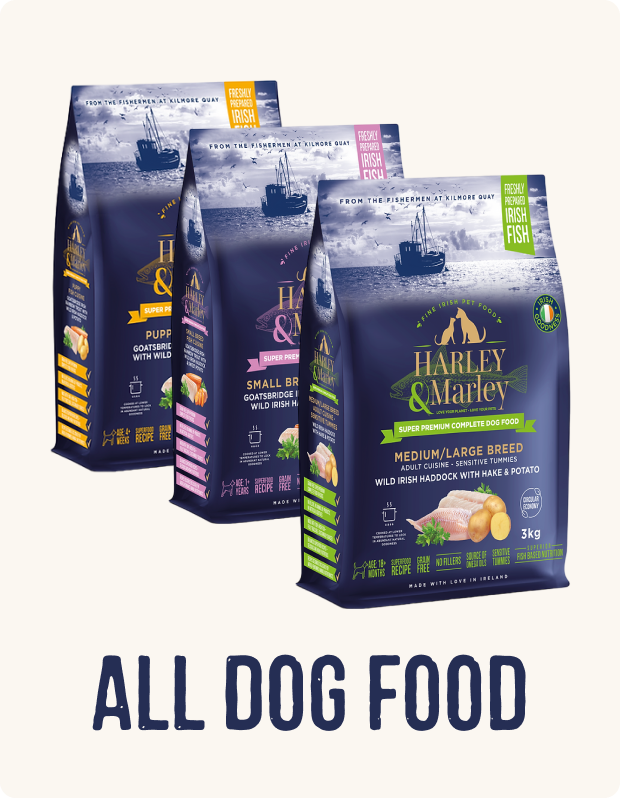
The range includes options for puppies, small breeds, medium and large breeds, and senior dogs. These categories can help you narrow your search, but they don’t replace checking the current product label. Confirm that the specific option is grain-free if that’s a requirement, and verify its ingredients, complete-food status and stated life-stage suitability before ordering.
What should you verify before choosing a product?
Match the food’s intended life stage and feeding guidance with your dog’s age, size and routine. Review the current ingredient list and nutritional information, and follow the feeding directions on the packaging. If you have a question about a product’s ingredients or label, contact the business for product information. For suspected sensitivities, symptoms or other health concerns, speak with a veterinary professional rather than relying on a food label to diagnose or treat the issue.
It’s the individual recipe that matters. Don’t assume every food in a range has the same ingredients, nutritional profile or suitability. Checking the label also helps you compare a fish-based option fairly with other foods: what it contains, what it’s intended to provide and whether it suits your dog.
How can food delivery fit your routine?
Food can be purchased individually, in bundles or through a monthly food box. These are purchasing formats, not different nutritional options, so choose according to your household’s feeding routine and available storage space. Before selecting a format, identify the specific food that suits your dog and check its label and feeding guidance.
Compare the product details with the checklist above, and choose only if the individual food fits your dog’s needs. Explore Harley & Marley’s dog food.
Choose with confidence, guided by your dog’s needs
Labels such as “grain-free” and “filler-free” are only a starting point. They don’t prove a food is more nutritious or right for every dog. Look beyond the front of the pack: check the ingredients, nutritional information, feeding guidance, and whether the individual food is complete and suitable for your dog’s life stage. If you suspect an allergy or have health concerns, ask your vet before changing the diet.
Harley & Marley is an Irish-owned business offering fish-based food, including grain-free options. Its range includes options for puppies, small breeds, medium and large breeds, and senior dogs. Check each product’s current label to confirm its ingredients, complete-food status and suitability for your dog.
Ready to compare? Explore Harley & Marley’s fish-based dog food and use the checklist in this guide to make an informed choice. Choosing dog food without grains or fillers needn’t mean choosing by claims alone. With careful label-reading and your dog’s individual needs in mind, you can make a considered choice.
Frequently Asked Questions
Is grain-free dog food better for dogs?
No, not automatically. Grain-free means grains are excluded, but that doesn’t establish a recipe’s nutritional quality or suitability. Check that the food is labelled for its purpose and your dog’s life stage, and consider their individual needs. If you’re thinking of changing food because of symptoms, a suspected allergy or an existing health condition, ask your vet first. A label claim can’t diagnose a problem or show that a diet will resolve it.
What does “dog food without fillers” mean?
“Fillers” is generally a marketing term, not a precise food category. It doesn’t identify the ingredients in a recipe or confirm whether it provides complete nutrition. For dog food without grains or fillers, read the full ingredient list alongside the nutritional declaration, feeding directions and stated purpose. Consider how the ingredients work together rather than dismissing one solely because its name is unfamiliar. The whole formulation matters more than a broad claim on the pack.
Can dogs eat grains in their food?
Many dogs can eat foods containing grains, though individual needs differ. The presence of grains alone doesn’t tell you whether a particular food is appropriate for your dog. Check the product’s intended purpose and life stage, and take your dog’s health history into account. If you suspect an adverse reaction, consult your vet before removing ingredients or changing food. Symptoms can have different causes, so guesswork may lead to an unsuitable diet or delay proper assessment.
How can I tell if grain-free dog food is complete?
Look on the packaging for a clear statement that the food is complete, then check the life stage or feeding purpose it’s intended to cover. “Grain-free” describes an ingredient exclusion, not nutritional completeness, and an ingredient list alone can’t confirm that the food is suitable as your dog’s main diet. Read the feeding directions, too. If the product label is unclear, ask the manufacturer for product information or speak with your vet.
Is grain-free dog food linked to heart problems in dogs?
Research has examined possible associations between some diets and canine dilated cardiomyopathy (DCM), a condition affecting the heart muscle, but this doesn’t mean every grain-free food causes heart disease. As of June 2026, the FDA had not established a direct causal relationship. A 2026 Dog Aging Project study found no statistically significant association between grain-free diets and new cardiac diagnoses. Discuss diet choices with your vet, particularly if your dog has health concerns.
How should I switch my dog to a new grain-free food?
Follow the transition directions supplied with the new food and monitor your dog’s appetite, stools and general wellbeing. The right approach may depend on your dog and the reason for changing their diet, and a gradual transition can’t prevent every digestive reaction. If symptoms persist, worsen or concern you, contact your vet. Changing food isn’t a substitute for investigating ongoing health problems, so seek advice rather than repeatedly switching recipes without guidance.
Is fish-based grain-free food suitable for every dog?
No single food suits every dog. Check the specific product’s current label for its ingredients, whether it’s complete, and the life stage it’s intended for. Consider your dog’s health needs and any veterinary advice before choosing. Harley & Marley is an Irish-owned business offering fish-based dog food, including grain-free options. Its range includes options for puppies, small breeds, medium and large breeds, and senior dogs; verify each product’s details before deciding.