




The biggest bottle of fish oil may not be the best choice for your dog’s joints. When claims promise easier movement, it’s understandable to wonder whether fish oil for dog joints can help, and how to tell useful label information from persuasive marketing.
Look beyond broad “joint support” wording. EPA and DHA are the omega-3 fatty acids to check, but the total amount of oil alone doesn’t tell you how much of either it contains. Liquid oil isn’t automatically a better fit than a chew, either. Serving instructions, ingredients and your dog’s health all matter.
This guide compares fish oil with joint-support chews by their ingredients, format and suitability. You’ll learn what to verify on the current label, what fish oil may and may not contribute to joint support, and what to ask your vet. A supplement is not a cure for joint disease, so use this information to make a considered choice rather than replace veterinary advice.
Key Takeaways
- Fish oil for dog joints may be worth discussing as part of nutritional support, but it isn’t a cure for joint disease.
- Compare the stated EPA and DHA amounts, full ingredients and serving directions, rather than judging fish oil by bottle size alone.
- Choose between liquid oil and joint-support chews based on your dog’s routine, then check each product’s label instead of assuming they share ingredients or effects.
- Ask your vet whether a supplement suits your dog, especially if they have health concerns or take medication.
- Fish oil and two chew formats are options to investigate. Verify current product details before choosing.
Fish oil for dog joints: what it can, and cannot, do
Wanting to help your dog move comfortably is understandable. Fish oil for dog joints is sometimes considered as part of nutritional support, but it should not be presented as a cure or a substitute for assessing pain. Fish oil supplies omega-3 fatty acids, including EPA and DHA. These nutrients have a biological role in the body, but seeing them in a product does not show that it will treat arthritis or improve mobility for a particular dog.
A change in how your dog walks, rises or uses the stairs may have several causes. A vet can assess those signs and discuss appropriate care. Nutrition may be one part of a broader plan, not a diagnosis.
In short: Fish oil may offer nutritional support, but only a vet can assess joint symptoms and advise on care for your dog.
What are EPA and DHA, and why do dog owners compare them?
EPA (eicosapentaenoic acid) and DHA (docosahexaenoic acid) are long-chain omega-3 fatty acids found in some fish oils. Omega-3 is a broader family of fats, including ALA, and the different types aren’t interchangeable by name alone. For a basic overview of the family and its types, see Omega-3 fatty acids.
Check whether the product label gives separate quantities for EPA and DHA, as well as clear serving directions. The total amount of oil, or the fish species listed as ingredients, doesn’t tell you how much EPA or DHA the product contains. If those figures aren’t stated, don’t estimate them from the source fish. Ask the manufacturer or your vet for clarification.
Does fish oil help dogs with stiff or painful joints?
Omega-3s are studied for their relationship with inflammatory processes, which is one reason they’re discussed in connection with joint support. That biological rationale is not proof that a standalone oil will relieve an individual dog’s stiffness or pain. It also doesn’t establish that a supplement treats arthritis.
Some findings relate to therapeutic diets enriched with omega-3s. Those results can’t automatically be applied to every fish-oil supplement: the diet, formulation and amount of nutrients may differ. Read claims carefully and look for product-specific information rather than assuming that “fish oil” guarantees a particular outcome.
If your dog’s mobility change is new, worsening or persistent, arrange a veterinary assessment rather than relying on a supplement trial. Share the product label and ask whether it’s suitable alongside your dog’s food, health conditions or medication. That conversation can help you weigh potential nutritional support against your dog’s individual needs.
What the evidence says about fish oil and canine joint support
There are three different questions behind claims about fish oil and joints: is there a biological reason to study omega-3s, what did the research actually test, and has a benefit been shown for this particular dog? Keeping those questions separate helps make sense of labels and marketing. A plausible mechanism is not proof of a treatment, and a study result is not a guaranteed outcome for an individual dog.
EPA and DHA are studied in relation to inflammatory processes. The American Kennel Club discusses possible support for dogs with conditions such as arthritis, but general information about potential support should not be mistaken for evidence that every oil improves joint comfort. The CARE resource describes evidence for fish-oil supplements as limited. The evidence available for one formulation or use may not apply to another.
Why omega-3 research does not make every supplement equivalent
Some research has examined therapeutic diets enriched with omega-3s. A complete diet is not the same as a standalone oil: its formulation, nutrient balance and amount of omega-3 studied may differ from what a retail supplement provides. Evidence for an enriched diet doesn’t automatically prove that a separate fish-oil supplement will produce the same result.
For a practical evidence check, ask what was studied, what form it took and whether the product label provides comparable information. If a label lists fish oil but not individual EPA and DHA quantities, you can’t assume it matches a research formulation. Avoid drawing conclusions from the ingredient name alone.
When should a vet guide a supplement decision?
Ask your vet before adding a supplement if your dog has diagnosed arthritis, another health condition or existing treatment. Do the same if your dog already eats a complete diet or receives other supplements. Your vet can consider the whole picture, including your dog’s health, current food and medication, rather than judging a product in isolation.
Fish oil shouldn’t replace prescribed medication, weight management or veterinary care. Don’t stop or change a treatment plan because a supplement claims to support joints. Instead, take the label to your vet and ask whether its ingredients and directions fit your dog’s needs.
Once you know what information to check, you can compare formats without treating them as interchangeable. Harley & Marley’s joint-mobility options include fish oil and joint-support chews. Review their current product labels and discuss suitability with your vet.
Fish oil or joint chews: how to compare the options
Liquid fish oil and joint-support chews are different product formats, not interchangeable recipes. Compare what each label actually discloses, how you’d give it as part of your dog’s routine, and what your vet recommends. A product’s joint-support positioning doesn’t establish that it will suit every dog or have the same effects as another format.
| What to compare | Fish oil | Joint-support chews |
|---|---|---|
| Format | Liquid, measured and given according to the product’s directions. | A chew or bite format; check the product page and label for how it’s intended to be given. |
| Label details | Look for full ingredients, serving directions, EPA and DHA quantities, and storage guidance. | Check the full ingredients, serving directions and warnings. Don’t assume chews contain fish oil or the same nutrients. |
| Routine and vet questions | Consider whether liquid is practical for your dog, and ask your vet about suitability and serving instructions. | Consider whether a chew fits your dog’s routine. Ask your vet about its ingredients and compatibility with food, supplements or medication. |
When might a liquid fish oil suit a dog’s feeding routine?
Liquid may be practical for owners who can follow measured serving directions, but your dog’s acceptance and the label’s instructions matter. Finest Fish Oil For Dogs & Cats is offered in 250 ml and 500 ml bottles and is described as made from Atlantic Salmon, Wild Irish Mackerel and Blue Whiting. Those fish sources don’t reveal the oil’s EPA or DHA amounts. Check the current label for these quantities, serving instructions and storage guidance before deciding whether it fits your routine.
How do the joint-support chew formats differ?
The joint-mobility collection also includes Joint Health Super Bites Functional Health Bites and Joint Health Chews Duo Function Health Chews for Dogs. Their names identify two chew options, but the available descriptions don’t establish their full ingredients, directions or suitability. Verify each current label rather than assuming the products share ingredients or effects. The AVMA review discusses fish oil’s therapeutic effects for several clinical disorders; that broader discussion doesn’t confirm the outcome of either specific chew.
Once you’ve identified the label details to check, explore the joint-mobility range as a set of options to investigate. For any format, review the full product information and ask your vet whether it suits your dog.
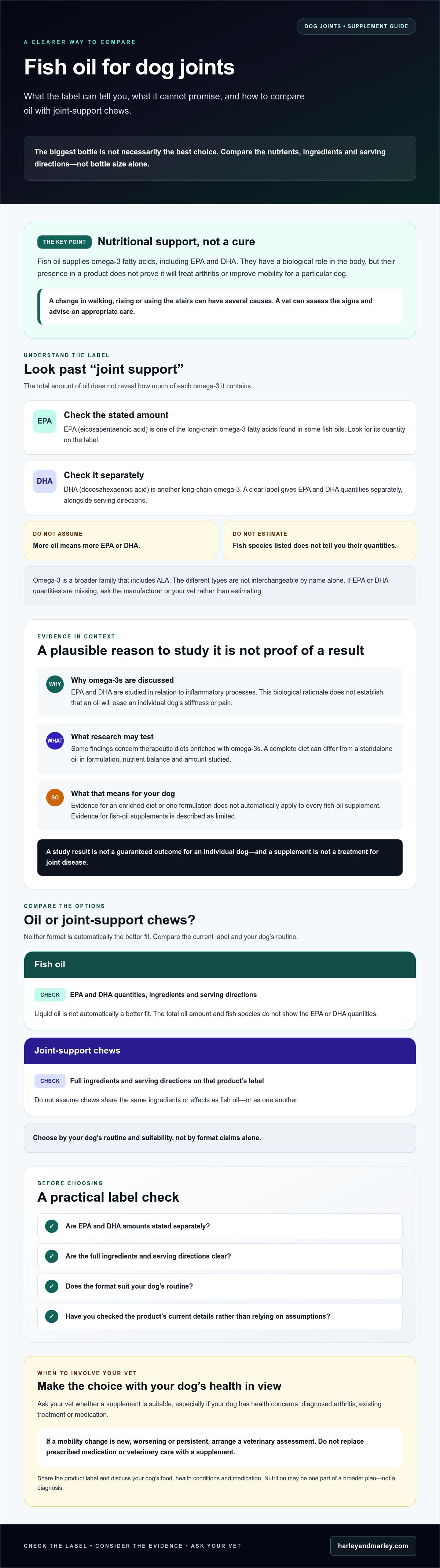
A practical checklist for choosing fish oil for dog joints
Use this checklist to decide whether a product is worth discussing with your vet. Start with your dog, not the marketing. A label can help you compare products, but it can’t determine whether a supplement is suitable or address the cause of mobility changes.
- Set your goal and consider your dog’s health. Note what you hope to support, and whether your dog has a diagnosis, health condition or prescribed treatment. Ask your vet before adding fish oil for dog joints if any of these apply.
- Read the complete ingredient declaration. Look for clearly identified fish sources and check for other listed ingredients. Don’t infer EPA or DHA content from the fish species.
- Check EPA and DHA quantities. See whether the label gives separate amounts for each, rather than only the total volume of oil. If the figures aren’t clear, ask the seller or your vet for clarification.
- Follow the product’s own serving directions. Don’t calculate a dose from body weight alone or transfer instructions from another oil or chew. Products can differ, so use the current label and get veterinary guidance if you’re unsure.
- Consider routine and palatability. Think about whether your dog will accept a liquid mixed with food or a chew, and whether you can follow the directions consistently. Check any storage guidance on the label, too.
- Review the whole supplement picture. Tell your vet what food and other supplements your dog receives. Ask about compatibility before combining products or changing prescribed care.
What to check on a fish-oil label before buying
Prioritise clear, specific information: fish sources, the complete ingredient declaration, EPA and DHA quantities, serving instructions and storage guidance. Total oil volume alone doesn’t show the amount of those omega-3s. If a detail is missing or unclear, don’t fill the gap with an estimate. Ask the seller or your vet, and wait for a clear answer before deciding.
Common mistakes when choosing a joint supplement
“Natural” and “joint support” are descriptions, not proof of a treatment effect. Avoid choosing solely by bottle size or flavour claims, and don’t assume products with similar marketing have matching ingredients or serving directions. Never combine supplements or adjust prescribed care without veterinary guidance. A careful label review and an individual discussion are more useful than guessing.
Ready to compare the available formats and product details? Explore the joint-mobility range, then check current labels and discuss suitability with your vet.
Choosing a Harley & Marley joint-mobility product and next steps
There isn’t one format that suits every dog. Start with the routine your dog will accept, then compare the current product information rather than choosing on the basis of a joint-support claim alone. Harley & Marley’s joint-mobility collection includes a liquid fish oil and two chew options to investigate. Their ingredients and directions differ, so check each label individually.
Which collection option should you investigate first?
If a liquid format seems practical, look at Finest Fish Oil For Dogs & Cats. It’s available in 250 ml and 500 ml bottles, and is described as produced from Atlantic Salmon, Wild Irish Mackerel and Blue Whiting. Those source details don’t establish the EPA or DHA amounts. Check the current label for those quantities, serving directions and storage guidance before considering whether the oil fits your dog’s routine.
If your dog is more likely to accept a chew, compare Joint Health Super Bites Functional Health Bites with Joint Health Chews Duo Function Health Chews for Dogs. These are separate chew formats. The supplied descriptions don’t provide enough detail to confirm their full ingredients or directions, so use the current product information rather than inferring what they contain from their names. Consider your dog’s preferences, but don’t assume that a preferred format is automatically suitable.
For wider diet context, consider how a supplement fits alongside your dog’s existing food and other additions. A fish-based nutrition guide can help frame that broader question; product-specific suitability still depends on the full label and your dog’s needs.
How to move from comparison to an informed decision
Before starting a supplement for a diagnosed joint problem, speak with your vet. Bring or share the product label, including the ingredient list, EPA and DHA quantities if stated, serving directions and any warnings. This gives your vet specific information to consider alongside your dog’s diagnosis, diet, other supplements and medication.
Keep the decision measured. Fish oil for dog joints is a product category to assess, not a guarantee of improved mobility or a replacement for veterinary care. If the label leaves key questions unanswered, pause and seek clarification instead of estimating a serving or borrowing instructions from another product.
Once you’ve reviewed the current labels and considered your dog’s routine, Browse Harley & Marley’s joint-mobility products to compare the collection options. For a diagnosed condition or questions about suitability, keep your vet central to the next step.
Choose a thoughtful next step for your dog
Choosing fish oil for dog joints is about more than a broad promise on a label. Check whether EPA and DHA amounts, ingredients and serving directions are clearly stated, and remember that evidence for one formulation doesn’t guarantee the same result from another. Fish oil and joint-support chews are different formats, so compare their current labels rather than assuming they share ingredients or effects.
Harley & Marley’s collection includes a liquid fish oil described as sourced from Atlantic Salmon, Wild Irish Mackerel and Blue Whiting, alongside two distinct joint-support chew products. These are options to investigate, not guaranteed treatments. If your dog has diagnosed joint problems, takes medication or has other health needs, discuss any supplement with your vet and keep the product label to hand.
To compare the formats and product information, browse the joint-mobility range. Review the current labels and discuss suitability with your vet before deciding what’s right for your dog.
Frequently Asked Questions
Can fish oil help dogs with joint stiffness?
Fish oil may provide nutritional support, but it isn’t a proven fix for every dog’s stiffness. Its omega-3 fatty acids, including EPA and DHA, are studied in relation to inflammatory processes, yet results from a particular diet or formulation don’t guarantee the same outcome from a standalone oil. If stiffness is new, persistent or worsening, arrange a veterinary assessment to help identify the cause and discuss suitable care.
Is fish oil safe for dogs with arthritis?
It may be suitable for some dogs, but don’t assume it’s right for every dog with arthritis. Health conditions, current medication, diet and other supplements can affect whether adding an oil is appropriate. Before starting, show your vet the product’s full ingredient list and directions, including any EPA and DHA amounts stated. Don’t use fish oil as a replacement for prescribed treatment or veterinary care.
How do I choose fish oil for my dog’s joints?
Choose fish oil for dog joints by checking the current label, not just the marketing claims or bottle size. Look for clearly identified fish sources, a complete ingredient declaration, serving instructions, storage guidance and separate EPA and DHA quantities. Consider whether your dog will accept a liquid and whether the directions are practical for your routine. Ask your vet about suitability, especially if your dog has a health condition or takes medication.
What is the difference between fish oil and joint-support chews?
Fish oil is a liquid product, while joint-support chews are given in a chew or bite format. They may have different ingredients and directions, so don’t assume a chew contains fish oil or provides the same nutrients or effects. Compare each product’s full label, serving guidance and warnings. Your dog’s preference can help guide format, but ask your vet whether the specific product is appropriate for their health and existing diet.
Can I give my dog fish oil every day?
Only follow a daily routine if the current product directions support it and it’s suitable for your dog. Serving instructions can vary between products, so don’t transfer directions from another oil or supplement. If your dog already eats a complete diet, takes medication or receives other supplements, ask your vet before adding fish oil. Keep to the product’s stated directions and seek advice if the label is unclear.
How much fish oil should I give my dog for joint support?
There isn’t a single amount that can be recommended for every dog or every product. Don’t calculate a serving from your dog’s weight alone: products can differ in concentration, and total oil volume doesn’t tell you the EPA and DHA amounts. Follow the current product label and ask your vet to assess the serving for your dog’s health, diet and medication. Never borrow directions from another product.
What should I do if my dog’s mobility is getting worse?
Contact your vet for an assessment rather than increasing a supplement or waiting to see whether it helps. Worsening mobility can have different causes, and a vet can advise on appropriate care for your dog. Note what changes you’ve observed and bring details of their food, medication and supplements. If you’re considering fish oil, take the product label along so its ingredients and directions can be reviewed.