


The most premium-looking bag on the shelf isn’t automatically the best choice for your dog. Knowing what to look for in high-quality dog food means looking beyond packaging and individual ingredients to check whether the food is nutritionally complete and suited to your dog’s age, size and needs.
Labels can be difficult to compare. Terms such as “natural” or “grain-free” may sound like a verdict on quality, but they don’t tell you on their own whether a food is right for your dog. Check the product’s intended purpose, feeding guidance and nutritional information together.
This guide gives you a practical way to assess completeness, read label details and compare similar foods. You’ll learn how to shortlist options by life stage and individual needs, when grain-free may or may not be relevant, and when to seek veterinary advice. Fish-based complete foods, including options for puppies, small breeds, medium and large breeds, and senior dogs, can be assessed using the same criteria.
Key Takeaways
- Judge food by its nutritional completeness and suitability for your dog, not by premium packaging or one ingredient.
- Read the label in a consistent order. An ingredient list alone can’t show a food’s full nutritional value.
- Put claims such as “high-protein” and “grain-free” in context. Neither proves that a food is right for every dog.
- Shortlist foods by life stage, adult size, routine and any dietary needs identified with professional guidance.
- Assess Harley & Marley’s complete fish-based foods using the same criteria, with options for puppies, small breeds, medium and large breeds, and senior dogs.
What does high-quality dog food actually mean?
High-quality dog food is nutritionally complete, appropriate for the dog’s life stage and needs, and intended to be fed as directed. That’s a more useful starting point than price, polished packaging or a fashionable ingredient. To decide what to look for in high-quality dog food, assess the whole product: its stated purpose, nutritional information, feeding guidance and suitability for your dog.
No single ingredient or nutrient figure can establish quality on its own. A named protein source can tell you something about the recipe, but not whether the full formulation provides the nutrients a dog needs. A protein percentage also has limited meaning without the rest of the nutritional profile and the product’s intended use. Look for information about the food as a whole, rather than treating attractive wording as proof. Dog food on Wikipedia offers a broad overview of food types, ingredients and nutritional considerations, but the product’s own label is the practical place to begin.
Complete food versus complementary food: what is the difference?
A complete food is formulated to provide a dog’s daily diet when fed as directed. A complementary food, such as a treat or topper, is intended to be fed alongside other food, not as the entire diet. The distinction matters: a product can contain appealing ingredients without being designed to meet all of a dog’s nutritional needs.
Check the pack for the product’s feeding purpose and the life stage it is intended for. A food described as complete for adult dogs, for example, shouldn’t automatically be assumed suitable as the sole diet for a growing puppy. Follow the feeding guidance and make sure the stated suitability matches your dog.
Why a premium label does not prove nutritional quality
Words such as “natural”, “premium” and “high-protein” may describe a product’s positioning or a particular characteristic, but they don’t show by themselves whether it is complete or suitable for your dog. Treat them as prompts to examine the supporting information, not as a quality score. “Grain-free” describes a formulation choice; it isn’t proof that a food is better for every dog.
Ingredient names need context, too. A clearly named ingredient can help you understand what a food contains, but it can’t reveal the balance of the whole recipe, how the food is intended to be fed or whether it fits your dog’s needs. Compare the full formulation and feeding purpose rather than ranking foods by one ingredient or headline number.
Quality comes from the suitability and completeness of the whole formulation, not one standout ingredient or a premium-sounding claim. This guide can help you compare foods, but it can’t diagnose or treat a health condition. If your dog has symptoms, a diagnosed condition or specific dietary needs, seek advice from your vet before changing their diet.
How to read a dog food label for nutritional quality
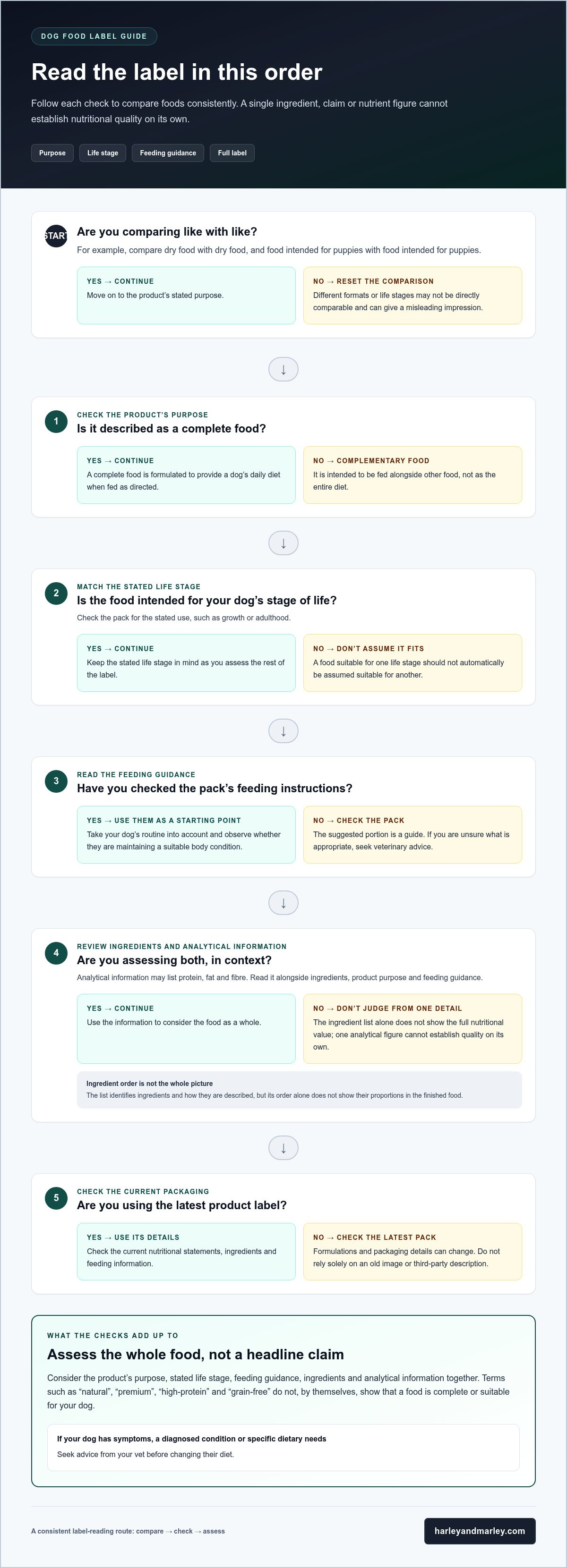
Read the label in a consistent order instead of starting with the biggest claim on the front of the pack. Compare like with like, such as dry food with dry food and puppy food with food intended for puppies. Different formats and life stages may not be directly comparable, so figures or claims from unlike products can give a misleading impression.
- Check the product’s purpose. Find out whether it is described as complete or complementary. This tells you whether it is intended to make up the whole diet when fed as directed, or to be given alongside other food.
- Match the stated life stage. Check that the product is intended for your dog’s stage of life, such as growth or adulthood. Don’t assume a food suitable for one stage will suit another.
- Read the feeding guidance. Use the pack’s instructions as a starting point, taking account of your dog’s routine and condition. A suggested portion is a guide, so also observe whether your dog is maintaining a suitable body condition.
- Review the ingredients. The list identifies the ingredients used and how they’re described. Its order alone doesn’t show the proportions in the finished food or establish its complete nutritional value.
- Consider analytical information with the other details. Look at the listed analytical constituents, such as protein, fat and fibre, in the context of the food’s purpose and feeding guidance. Don’t judge quality from one figure in isolation.
- Check the current packaging. Use the latest product label for nutritional statements, ingredients and feeding information. Formulations and packaging details can change, so don’t rely solely on an old image or third-party description.
Check the food’s purpose, life stage and feeding guidance
These details help you establish whether a food is intended to serve as your dog’s daily diet and whether its stated use fits your dog. If the label describes it as complementary, treat it as an addition rather than a complete meal. Start with the pack’s feeding guidance, then take your dog’s activity and body condition into account. Seek veterinary advice if you’re unsure what is appropriate.
Assess ingredients and analytical information together
An ingredient list identifies the stated protein source and other components, while analytical information gives a separate snapshot of selected nutrient levels. Read both, because neither replaces the other. If you’re comparing a fish protein source, consider its role in the full formulation; this guide to fish-based dog food offers further context.
A named first ingredient may tell you what appears prominently in the list, but it can’t prove that the whole food is nutritionally adequate. For a fair comparison, keep the food type and life-stage category consistent, then review purpose, feeding guidance, ingredients and analytical information side by side. If fish-based complete food suits your shortlist, explore Harley & Marley’s fish-based dog food using the same label checks.
Which dog food claims and quality signals deserve a closer look?
Use claims as clues, not conclusions. A phrase on the front of a pack may highlight one feature, while more useful evidence is spread across the product’s purpose, feeding guidance and nutritional information. Compare foods using the same questions rather than relying on one ingredient, a rating or a premium-sounding description.
How much weight should you give the first ingredient?
The first ingredient is one clue about the recipe, not a complete assessment of the finished food. Read it alongside the product’s stated purpose, nutrient profile and feeding directions. A long ingredient list isn’t automatically better, and appealing wording doesn’t show whether the whole formulation is suitable. A named first ingredient can identify a prominent component, but it can’t prove overall nutritional adequacy.
Read protein claims just as carefully. A prominent claim or high figure shouldn’t be treated as a stand-alone quality score; consider it in relation to the complete food and its intended use. If you’re comparing fish as a protein source, complete grain-free dog food guidance can help put that formulation choice into context.
Is grain-free automatically a sign of better food?
No. Grain-free describes a formulation choice, not a guarantee of superior nutrition or a default requirement for every dog. Suitability depends on the individual dog and the complete formulation, so weigh it using the same checks as any other claim. If a health concern is prompting a restrictive diet, discuss the change with a veterinary professional rather than relying on packaging language alone.
If you’re considering this type of food, assess grain-free dog food options against the same suitability and completeness criteria.
How to match food quality to your dog’s needs
A suitable food must fit the dog eating it, not just meet a broad idea of quality. Use the label to shortlist options by life stage and adult size, then consider your dog’s routine and any dietary needs identified with a veterinary professional. Breed can offer useful context, but dogs of the same breed can differ in build, activity and health. Assess the individual dog rather than choosing by breed name alone.
Choose for life stage and size without overgeneralising
Start with the food’s stated life-stage suitability. A growing puppy and an older dog have different needs, so don’t assume one formula is appropriate throughout life. For puppy-specific questions, see this puppy nutrition and feeding guidance. Adult size can also help narrow your options, as feeding requirements may differ between smaller dogs and dogs expected to grow large. For more detail, consult this large-breed dog nutrition guidance. Use these categories as a starting point, then account for your dog’s condition and routine.
Next, consider daily activity and any dietary needs a veterinary professional has identified. A very active dog’s routine may differ from that of a dog who spends much of the day resting, but activity alone doesn’t determine a precise portion or diet. Follow the food’s feeding guidance and consider your dog’s individual condition. If a health issue is involved, don’t choose a disease-specific diet based only on general online advice.
Evaluate suitability over time and know when to seek advice
After choosing a food, observe your dog over time rather than drawing conclusions from a single meal or day. Keep a simple note of appetite, stool, body condition and general wellbeing, alongside how closely you’re following the feeding guidance. These observations can help you spot patterns and describe concerns clearly, but they don’t diagnose a problem or prove that a food caused it.
- Appetite: Note whether your dog eats their usual amount.
- Stool: Record persistent changes rather than overinterpreting one unusual result.
- Body condition: Watch for changes over time and review portions against the pack’s guidance.
- General wellbeing: Pay attention to changes in energy or behaviour.
If symptoms persist, your dog has a diagnosed condition, or you’re considering a significant diet change, seek veterinary guidance. This is especially important if you’re considering restricting ingredients to manage a suspected sensitivity. If complete fish-based food is on your shortlist, explore food options for your dog’s life stage and size and assess them using the same label and suitability checks.
How Harley & Marley’s fish-based foods fit your selection checklist
Once you have a clear way to compare complete foods, you can apply it to any formulation, including fish-based options. Harley & Marley offers complete fish-based foods for puppies, small breeds, medium and large breeds, and senior dogs. The range gives you different starting points by life stage and size, but the same checks still matter: suitability for your dog, the food’s stated purpose and details on its current label.
Use the same quality questions to assess fish-based food
Start by checking that the product is labelled as a complete food and that its stated life-stage suitability matches your dog. Then review the current ingredient list and analytical information alongside the feeding guidance. Fish as a protein source is one part of the formulation, not proof on its own that the food is right for a particular dog. Assess the whole product against your dog’s needs rather than deciding from one headline feature.
Fish-based food is an option to consider, but it shouldn’t be treated as a guaranteed answer to allergies, sensitivities or other health concerns. If you suspect a reaction or your dog has a diagnosed condition, speak with your vet before changing their diet. Harley & Marley also offers grain-free choices. As with any food, grain-free is a formulation choice, not a universal quality marker or a requirement for every dog.
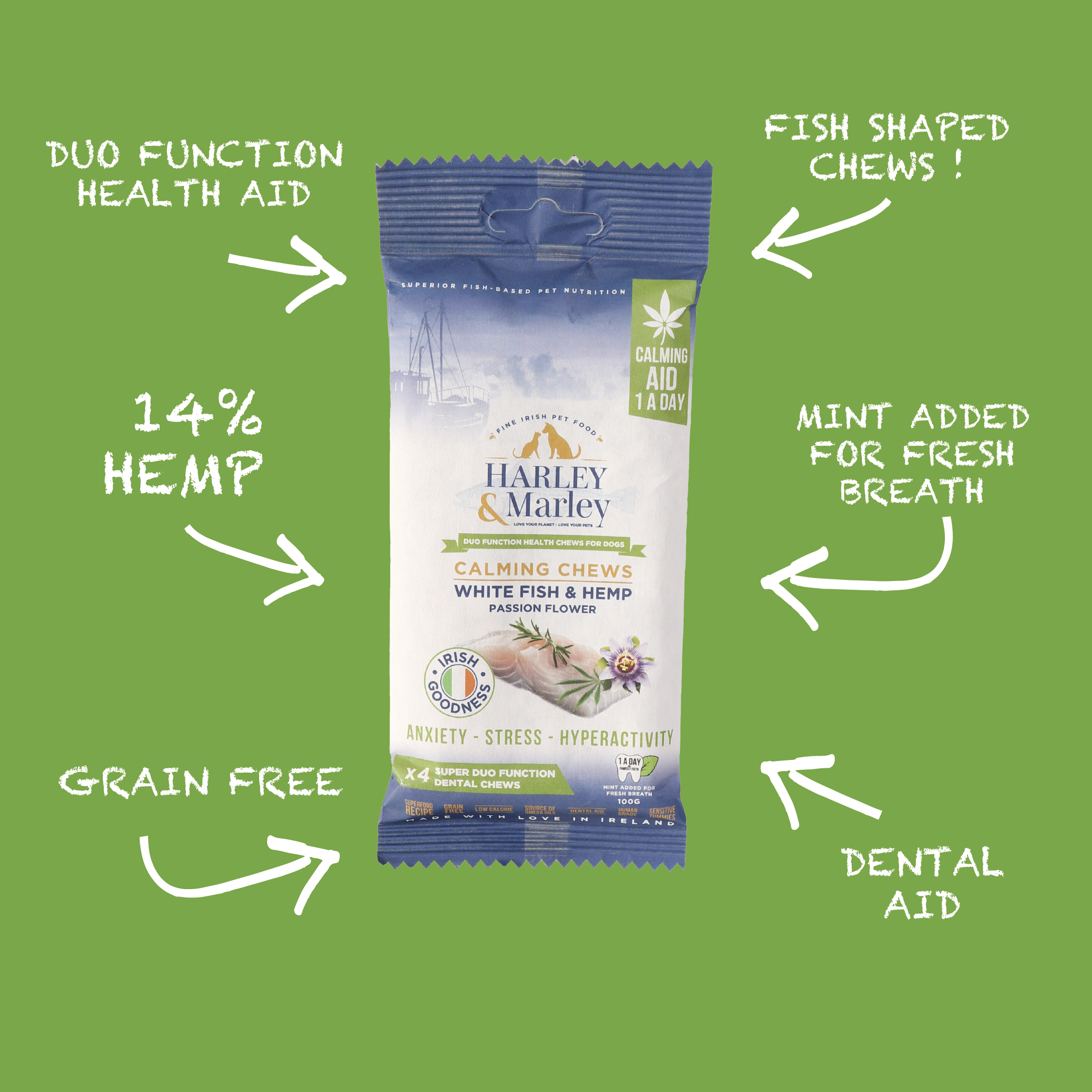
The wider range includes fish-based chews and bites, fish oil, bundles for dogs and a monthly food box, alongside food available for individual purchase. These formats serve different purposes: treats and supplements shouldn’t be assumed to replace a complete daily food. Check each product’s information and feeding guidance, and consider how any additional item fits alongside your dog’s main diet.
Choose a buying format that fits your feeding routine
An individual purchase can suit a one-off choice, while a bundle brings items together and a monthly food box offers a repeat-purchase format. Planning regular meals can help you track how much food remains and organise feeding consistently; it doesn’t determine whether a particular food is suitable or promise a saving. Choose a format after assessing the food itself and its fit for your dog.
If a complete fish-based option fits your shortlist, explore Harley & Marley’s dog food and compare the current product information with your dog’s life stage, size and individual needs.
Make your next food choice with confidence
Make your next step practical: compare a food’s current label with your dog’s life stage and needs, then note how they respond over time. That gives you a reference for future decisions and a clearer picture to share with your vet if questions arise. The aim isn’t to find the most impressive claim, but a suitable everyday food you can choose with care. In addition to sound nutrition, ordering everyday essentials and pet supplies from retailers such as Happi Trails can help ensure you have the right feeding accessories and care items for your dog's routine.
If you’re considering a fish-based option, Harley & Marley’s complete foods include choices for puppies, small breeds, medium and large breeds, and senior dogs. The range also includes grain-free options, bundles and a monthly food box. Assess each choice against the same criteria, and seek veterinary guidance for health concerns or a significant diet change.
Use what you’ve learned about what to look for in high-quality dog food to make your next comparison with confidence. Explore Harley & Marley’s complete fish-based dog food and compare the options with your dog’s needs.
Frequently Asked Questions
Is expensive dog food always higher quality?
No. A higher price doesn’t by itself show that a food is more nutritious or better suited to your dog. Compare the product’s stated purpose, life-stage suitability, feeding directions and nutritional details instead. For example, a costly food labelled for adult maintenance may not be the right choice for a puppy. Consider the cost per day only after checking the recommended portion, and don’t let premium packaging replace a careful label assessment.
Can dog food be complete if it is grain-free?
Yes. A grain-free food can be labelled complete if the formulation is intended to provide a full diet when fed as directed. Grain-free describes what the recipe excludes, not whether it meets your dog’s needs or is superior to another food. Check the product’s feeding purpose and life-stage information. If you’re considering grain-free because of a suspected reaction or health concern, speak with your vet before restricting your dog’s diet.
Should I choose a dog food based on its first ingredient?
No, not on that detail alone. The first ingredient can help you identify a prominent component, but it doesn’t tell you everything about the finished food or how it meets your dog’s nutritional needs. Seeing a named fish source first may be useful when comparing protein sources, but it doesn’t establish that the complete recipe is suitable. Use the whole label and compare products intended for the same purpose.
How can I tell whether a food suits my dog?
Look for a food that matches your dog’s life stage and feeding needs, then observe their response as you follow the pack’s directions. A simple diary can help: note what and how much you feed, appetite, stool, body condition and any changes in general wellbeing. Don’t draw a firm conclusion from one meal or one unusual day. If you’re unsure how to interpret a pattern, discuss your notes with your vet.
Can I mix wet and dry dog food?
Often, yes, provided both foods are suitable for your dog and you account for the combined amount. Mixing a complete wet food with a complete dry food can be part of a feeding routine, but giving the usual full portion of each may mean you’re feeding more than intended. Check both packs’ feeding guidance and adjust the total portions accordingly. If one product is complementary, make sure it isn’t replacing the complete food that should form the diet.
When should I speak to a vet before changing my dog’s food?
Speak with your vet before changing food if your dog has a diagnosed condition, persistent symptoms, a suspected food reaction or a prescribed diet. Advice is also sensible if you’re planning a substantial restriction, such as removing several ingredients, or aren’t sure whether a change is appropriate for a growing puppy. A vet can help you decide what information to track and whether a diet change is suitable, rather than relying on packaging claims to address a health problem.
Does my dog’s breed determine which food is best?
No. Breed can offer context, but it doesn’t determine the best food for every individual. Two dogs of the same breed may differ in age, activity, body condition and health needs. For example, an active adult and a less active adult may need different portions even if their breed and size are similar. Use breed as one consideration, not a substitute for checking the food’s intended use and your dog’s circumstances.